Field Photography · PhotoPills · Lesson 11 Meteor Showers
1 / 10
Field Photography · PhotoPills
Meteor Showers
Panel 11 in the Planner gave you the basics. The standalone Meteor Shower pill goes much further — a full calendar, quality ratings, and an AR view built specifically for framing a shower.

Find it in the Pills menu. Like the Sun and Moon pills, it works offline and defaults to your current location — perfect for checking tonight's odds without a signal.

Field Photography · PhotoPills
The Meteor Shower Pill: Info
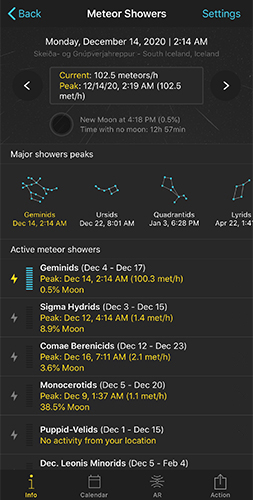
Meteor Showers Info screen showing current meteors per hour, major shower peaks as constellations, and a list of active meteor showers with moon percentage
Every active shower for tonight, ranked and ready

The big box up top shows the combined rate — meteors per hour — for all active showers at your location right now. Below it, Major Shower Peaks gives you a quick shortcut to the year's best displays, and Active Meteor Showers lists everything currently running.
Field Photography · PhotoPills
Reading The Energy Bar
  1. 🔋
    The energy bar
    Next to each shower's name — the more filled it is, the better your odds of actually capturing meteors.
  2. 🌙
    Moon percentage
    A bright Moon washes out fainter meteors, just like it does the Milky Way. Lower is better.
  3. ⏱️
    Scroll down for more
    Sun/Moon/Galactic Center rise-set times, a peak-intensity graph, and azimuth/elevation for every active radiant.
Field Photography · PhotoPills
The Calendar: A Whole Year At A Glance
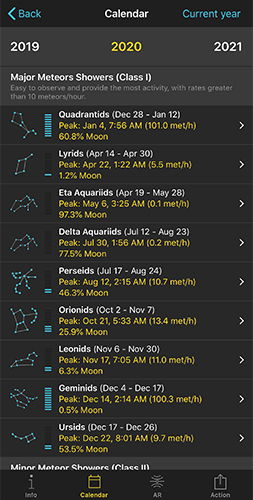
Meteor Showers Calendar screen listing Major Meteor Showers Class I with constellation icons, peak dates, and moon percentages
Every major shower of the year, sorted by class

Swipe between years and browse every shower PhotoPills tracks. Tap one to see its full profile — activity period, peak time, radiant coordinates, and velocity.
Field Photography · PhotoPills
The Four Shower Classes
🔥
Class I
Easy to observe — more than 10 meteors/hour. Perseids, Geminids, and the like.
Class II
Harder to distinguish — roughly 2 to 10 meteors/hour.
💫
Class III
Rare strong activity, usually under 1 meteor/hour.
🌫️
Class IV
Too weak for the naked eye — rarely above 2 meteors/hour.
🎯
Start with Class I
For a first meteor shower shoot, stick to Class I showers — you'll actually see results.
Field Photography · PhotoPills
Meteor Showers In AR
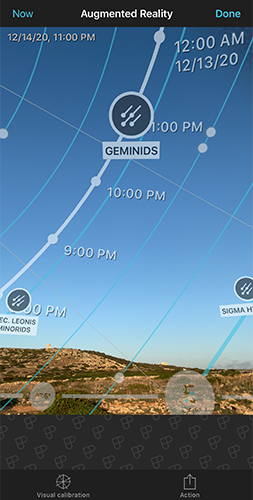
Augmented reality view showing the Geminids meteor shower radiant path overlaid on a real evening landscape, with time markers
The radiant's path traced right over your composition

Point your phone at the sky and PhotoPills draws the radiant — the point all meteors in a shower appear to streak from — directly onto the real scene. Swipe left/right to see how it moves across your shooting window, from start to finish.

Field Photography · PhotoPills
Composition Tips
  1. 📐
    Frame away from the radiant for longer tails
    The further a meteor appears from the radiant, the longer its streak looks.
  2. 🔭
    Or include the radiant for a "starburst" effect
    Stack multiple frames in post and every meteor appears to radiate from one point.
  3. 🌐
    Go as wide as you can
    More sky in frame means more chances to catch a meteor.
  4. 🏔️
    Don't forget the foreground
    A strong foreground subject turns "photo of the sky" into an actual photograph.
Field Photography · PhotoPills
Getting The Info Out

Tap Action from any screen in the pill to share a screenshot, save it to your camera roll — or, from the Info screen specifically, send the date and time straight to the Planner or add a calendar alert so you don't miss the peak.

Field Photography · PhotoPills
Planning A Meteor Shower Shoot
  1. 1
    Find a good Class I shower
    Check the Calendar for a peak with a strong energy bar and low Moon percentage.
  2. 2
    Check the details on Info
    Confirm peak time and no-moon hours for your location.
  3. 3
    Frame it with AR
    In the field, use AR to decide how close to (or far from) the radiant you want to shoot.
  4. 4
    Save the plan
    Send it to the Planner so the whole date/time/location package is ready to go.
Field Photography · PhotoPills
You're Ready For The Next Shower
1
Info
Tonight's rate & energy bar
2
Calendar
A full year, by class
3
AR
Frame the radiant
4
Action
Save it, get reminded
UP NEXT
Lesson 12: Time Lapse & Intervals
Shooting a meteor shower as a time lapse instead of single frames? The Time Lapse calculator figures out your interval timing for you.
⌂ Index